)
)
)
Rethinking Leadership, Learning and the Role of HR
Organisations are entering a new era of work, where AI is changing not only how work gets done, but how organisations think about leadership, capability and organisational design.
As the role of HR and L&D continues to evolve, practitioners are facing some important questions. What conversations should people leaders be having more often? Where can people teams have the greatest strategic impact? And what aspects of leadership, learning and people strategy need to be rethought?
Ahead of HR + L&D Innovation & Tech Fest Australia 2026, we spoke with a few of our expert speakers to get their perspectives.
Preeti Verma, People, Initiatives and Transformation Leader, Atlassian
What’s one conversation people leaders should be having more often right now?
The shift from "cost per FTE" to "cost per unit of output." Most senior leaders still plan teams around headcount. AI has already changed the denominator; what matters now is the output a team produces relative to total investment, not how many people sit on the roster. A recent study of 12,000+ knowledge workers found that 85% already use AI at work, but only 29% have embedded it into their actual workflows. The gap between individual adoption and team-level integration is where value disappears. 89% of executives say AI increases speed, yet only 6% can point to clear examples of organisation-wide ROI. The productivity gains are real at the individual level, but they're not compounding into team or business outcomes.
When you measure cost per unit of output instead of cost per FTE, the conversation changes: Which work should be automated entirely? Which roles become orchestration roles? Where does human judgement add irreplaceable value? Senior people leaders should be driving these questions before finance or operations force them.
Where do you see the biggest opportunity for HR and L&D teams to shape the strategy of their organisations over the next few years?
Becoming the architects of new operating models, not just the managers of talent pipelines. AI is creating a coordination problem that no other function is positioned to solve – and most organisations are ignoring it. Research shows that AI's hidden cost is a "fragmentation tax" as individuals use AI to produce more, faster, team coordination breaks down. Sign-offs, reviews and alignment decisions can't keep pace. 87% of knowledge workers say they lack the time or capacity to coordinate when everyone is in execution mode.
Only 24% of leaders are focused on using AI to improve how teams work together. The rest are still optimising for individual productivity. This is the gap HR and L&D should own: not "How do we train people on AI tools?" but "How do we redesign team structures, rituals and ways of working for an AI-augmented organisation?" The organisations seeing real returns – the top 14% – are 9.4x more likely to report that AI increases collaboration, not just speed. They've invested in working agreements, team-level AI norms and deliberate coordination systems. This is L&D and HR strategy work, not IT rollout work.
One practical example: teams that co-created AI working agreements saw 82% stronger alignment on how to use AI, and 75% discovered new use cases they hadn't considered. A 60-minute team exercise. Measurable shift.
What’s one area of leadership, learning or people strategy that organisations need to rethink?
Leadership development built for hierarchies that AI is about to flatten. Most leadership programs still train people to manage up and down a vertical chain. The data says organisations are heading somewhere very different. 70% of executives expect AI to create more collaborative, cross-functional roles. 77% expect flatter team structures with fewer management layers. Yet most leadership development still focuses on span of control, performance calibration and cascade-style communication – skills designed for a hierarchy that's dissolving.
55% of executives say AI is already widening performance and capability gaps between teams. The risk isn't just that some individuals fall behind – it's that entire teams become structurally disadvantaged. Senior people leaders need to rethink how they distribute AI capability across the organisation, not leave it to individual motivation. The next generation of leaders will need to orchestrate human-AI teams, make decisions about what to automate versus what to keep human, and build culture in flatter, more fluid structures. L&D programs that still centre on "managing your direct reports" are training for yesterday's organisation chart.
Anchal Saxena, VP of Transformation, CBRE
What's one conversation people leaders should be having more often right now?
What work should we stop doing - not just what can AI do.
Most leaders are stuck on the first question. The tools are exciting, so the conversation drifts to features and pilots. The harder, more useful conversation is about the work itself: what should our people stop doing, what should they do instead, and how do we redesign roles around that. If we free up capacity and then quietly refill it with more of the same, we've missed the point. Leaders should be talking openly with their teams about what changes, what doesn't, and where the freed-up time goes.
Where do you see the biggest opportunity for HR and L&D teams to shape the strategy of their organisations over the next few years?
We're sitting on the two things this shift needs - deep knowledge of how work gets done, and the data behind it. That makes HR and L&D the natural architects of the operating model, not just the function that supports it.
The opportunity is to move from administering people to designing how humans and agents work together - process, capability, and org design as one system. For L&D specifically, it's a shift from delivering courses to building capability at the point of work, so people can work alongside these tools with confidence. If we take that seriously, HR stops being downstream of strategy and starts shaping it.
What's one area of leadership, learning or people strategy that organisations need to rethink?
How people learn and progress early in their careers. For decades, juniors learned the job by doing the repetitive, administrative work and that grunt work quietly built judgement, context, and confidence. Agentic AI is now taking a lot of that away. That's a good thing for productivity, but it breaks the model we've relied on without really examining it. So we need to rethink how people build mastery when the traditional first steps of the ladder disappear. What replaces learning-by-doing the basics? How do we deliberately create the experiences that used to happen by default? If we don't design for this now, we'll have a capability gap in five years that no amount of tooling will fix.
Lauren Anderson, Senior Talent Strategy Advisor, Indeed
What’s one conversation people leaders should be having more often right now?
The conversation I think people leaders should be having more often is about how we can reinvigorate the application process. Not whether to scrap the CV and the cover letter, but whether those tools, so easily optimised by AI now, still work as a genuine filtering step towards a higher quality funnel, and if not, what are the out of the box, first wave creative solutions to do that.
Where do you see the biggest opportunity for HR and L&D teams to shape the strategy of their organisations over the next few years?
I think the opportunity for HR and L&D to shape strategy sits around transparency on AI usage. Candidates are already asking how AI is being used in the hiring process. This demand is a canary in the coal mine for what customers and employees will soon expect regarding AI usage across the whole business. HR and L&D are positioned to lead that conversation first, to set the organisation's stance on AI and communicate it in a way that's accessible, and the candidate experience is where that starts.
What's one area of leadership, learning or people strategy that organisations need to rethink?
The area of people strategy could rethink is how they encourage and platform their own team's generated content. AI increasingly determines findability, pulling from user generated content, reviews, social posts, the things employees say unprompted, not just what's on the careers page. Most attraction strategies don't reflect this. The opportunity is to actively grow and platform genuine employee voice as part of the employer brand, rather than leaving it to chance.
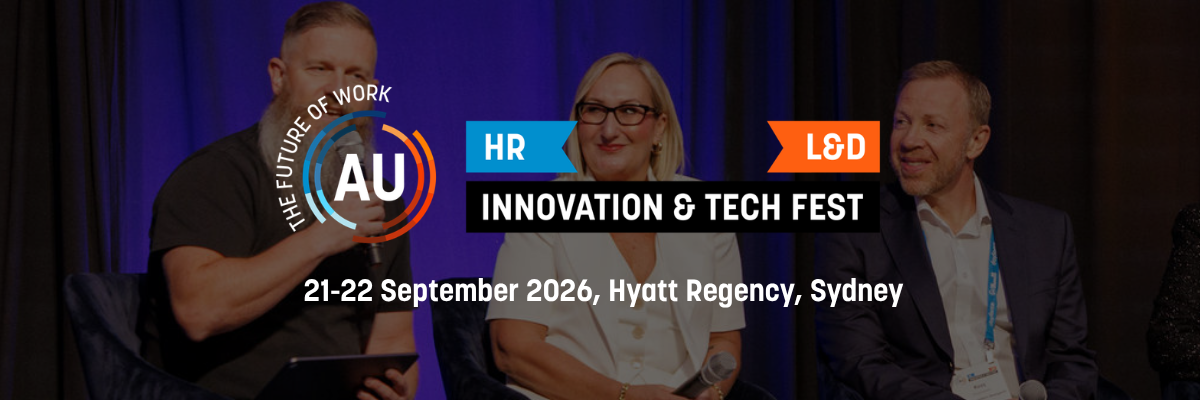
Continue the conversation at HR + L&D Innovation & Tech Fest Australia, where HR, L&D and people leaders will explore the ideas, strategies and technologies shaping the future of work.
21-22 September 2026 | Hyatt Regency Sydney
This is an event not to be missed.
Secure your tickets online or get in touch with the team.
)
)
)
)
)
)
)
)
)
)
)
)