)
)
)
What Does the Future of Work Really Look Like and How Do We Prepare for It?
 Organisations today are navigating an environment defined by constant change. Emerging technologies, evolving workforce expectations, and new ways of working are challenging leaders to rethink how they build capability, develop talent, and support their people.
As organisations adapt, they are faced with some important questions. What skills will matter most in the years ahead? How can leaders create clarity in increasingly complex environments? And how do we embrace change while keeping people at the centre of it?
Ahead of HR + L&D Innovation & Tech Fest NZ, we spoke with a few of our expert speakers to get their perspectives.
Roxanne Pascoe, Director, Learning & Organisational Development, New Zealand Trade & Enterprise
What changes are you currently seeing in how organisations are approaching leadership, learning, or workplace culture?
What I’m seeing is leadership needing to shift from creating certainty in organisations to navigation. In a more volatile geopolitical and economic environment, leaders aren’t expected to have all the answers anymore; they’re expected to create clarity and help their people move forward through ambiguity. AI is a great example of this. We know it will change how we work, but we don’t yet know exactly where it will take us.
At the same time, learning and capability building are becoming much more embedded in the flow of work. Organisations are moving away from traditional programmes towards more practical, in-role development, coaching, real-time feedback, and solving live business challenges. We're seeing the impact of this firsthand through action learning projects that bring cross-functional teams together to solve organisational challenges while building capability in real time.
Culturally, organisations need to become more comfortable with experimentation. Many say they value innovation, but still expect polished, low-risk outcomes. The shift isn't just behavioural - it's psychological and systemic.
What’s one mindset shift you think organisations need to make over the next few years?
I think the critical shift is moving from managing execution to leading through complexity. For a long time, leadership was about delivering outcomes in relatively stable environments. Today, organisations are operating in a context shaped by uncertainty, shifting priorities, and competing demands, where the path forward isn't always clear.
That means leaders need to become comfortable making decisions without perfect information, creating clarity when circumstances are changing, and empowering their people to act rather than wait for everything to be defined. At its core, leadership is shifting from controlling the work to creating the conditions where good decisions can happen consistently and at pace.
What’s one skill, capability or behaviour you think will become increasingly important in the future of work?
For me, it’s sensemaking. We’re moving into a world where there’s more information than ever before - data, insights, and increasingly AI-generated outputs. But the challenge isn’t access to information; it’s interpretation. Leaders need to be able to connect the dots across multiple signals, including global context, organisational priorities, and what they’re seeing on the ground. That’s where sensemaking becomes so important. It’s about turning complexity into clarity and helping teams understand not just what’s happening, but what it means for them and what they should do next.
The leaders who create the most momentum will be those who can cut through the noise, provide a clear narrative, and give people the confidence to move forward, even when the full picture isn’t known. As AI continues to accelerate the volume of information available, the human capability to interpret, prioritise, and create meaning will only become more important.
Peter Keegan, Independent People and Culture Consultant
What changes are you currently seeing in how organisations are approaching leadership, learning, or workplace culture?
There's a return to basics. Organisations are rebuilding capability frameworks from the ground up, starting talent mapping exercises, and focusing on future capabilities rather than maturing what's already in place. The conversation has shifted from optimising existing systems to asking more fundamental questions: what do we actually need our people to be good at, and are we building toward that deliberately?
What's one mindset shift you think organisations need to make over the next few years?
Lean into change rather than manage it from a distance. AI-embedded systems are becoming standard, and organisations that wait for natural transition points (contract renewals, licence expiries) risk falling behind. The shift is recognising that actively seeking change, even before it's convenient, is now part of good organisational practice. Standing still has become the riskier option.
What's one skill, capability or behaviour you think will become increasingly important in the future of work?
People leaders need to learn how to coach AI use. As AI becomes a core part of how work gets done, the ability to guide teams in using it well, openly and effectively, will matter more than technical expertise alone. Leaders who treat AI use as something to manage quietly will lose ground to those who make it a normal, visible part of how their teams operate.
Nina Field, Business Psychologist
What changes are you currently seeing in how organisations are approaching leadership, learning, or workplace culture?
As change gathers pace and technologies become more capable, I see leaders coming under more and more pressure to see the way forward quickly and clearly. But this is not just for the top table. Leaders at all levels need to think their way through how the organisation is going to succeed. When execution, analysis, and even parts of decision support can be augmented by technology, the premium moves to judgement - deciding what is important, why it matters, and where effort should be focused in order for strategy to be turned quickly into reality.
What's one mindset shift you think organisations need to make over the next few years?
Organisations need to get comfortable working with uncertainty rather than waiting for it to pass. Strategic thinking often requires choosing without complete information and the environments we're operating in now mean that's not a temporary inconvenience; it's the permanent condition. The mindset shift is accepting that there are no right answers and no crystal balls, and that waiting for certainty is itself a decision.
Alongside that, more data and more options don't automatically lead to better outcomes. They can just as easily create noise and indecision. The shift is understanding that clarity about direction and the discipline to commit despite uncertainty are more valuable than having the perfect picture before you act.
What's one skill, capability or behaviour you think will become increasingly important in the future of work?
Well, I might be biased, but for me it's strategic thinking. Senior leaders are paid to think. As environments become more complex and fast-moving, and as AI changes the nature of work, that becomes more true, not less. The core skill is making sense of a changing context and knowing what to do with it. The critical enabling capability for strategic thinking though – it’s cognitive capacity. Its being able to create the time and headspace to look up and notice what’s going on around us and what it means. Strategic thinking is the differentiator, but capacity for strategic thinking is the enabler.
Michal Pawlowicz, Head of Learning & Organisational Development, Hind Management
What changes are you currently seeing in how organisations are approaching leadership, learning, or workplace culture?
I'm seeing a lot of organisations focus on AI and digital transformation, which is understandable given the pace of technological change. However, there’s a risk of jumping on the AI bandwagon without first asking some important questions: What problem are we trying to solve? How will this help our people and customers? And what impact might it have on the employee experience? AI has enormous potential, but technology should support people, not become the goal itself.
At the same time, leadership is becoming more human-centred. Organisations are placing greater emphasis on communication, coaching, wellbeing, and creating positive team experiences, rather than focusing solely on performance and results.In learning and development, there is growing demand for practical, relevant learning that can be applied immediately.
People want real workplace examples and opportunities to learn while doing the job, with the focus shifting from completing training hours to creating meaningful behaviour change. When it comes to workplace culture, belonging and purpose remain important. Culture initiatives need to feel authentic and connected to what people truly value, rather than being seen as superficial perks.
What’s one mindset shift you think organisations need to make over the next few years?
Organisations need to spend less time asking what's new and more time asking what problem they're trying to solve. Sometimes we become so excited about a new platform, methodology, trend, or workplace initiative that we forget to ask whether it's actually solving a meaningful business or people challenge. I've seen organisations invest heavily in new systems while managers are still struggling to have basic development conversations with their teams. Technology can absolutely help, but it shouldn't distract us from the fundamentals.
Not every challenge requires a new system. Sometimes the answer is better leadership, clearer communication, simplifying the way work gets done, or investing more in people. When people feel supported, have opportunities to grow, and understand what's expected of them, many of the outcome’s organisations are looking for tend to follow naturally.
What’s one skill, capability or behaviour you think will become increasingly important in the future of work?
If I had to choose one capability, I would say human skills. By that, I mean empathy, communication, critical thinking, self-awareness, relationship building, and judgement. The future of work will continue to require technical skills and digital literacy, but these human skills are what help us lead teams, navigate complexity, build trust, and make sense of situations where there isn't a clear or obvious answer.
In my experience, the most successful leaders aren't necessarily the ones with the most expertise. They're the ones who can communicate clearly, listen well, build relationships, and help others succeed. Technology will continue to evolve, but our ability to understand people, connect with others, and exercise good judgement will remain incredibly valuable. The organisations that will do well in the future will be the ones that use technology effectively without losing sight of the human side of work.
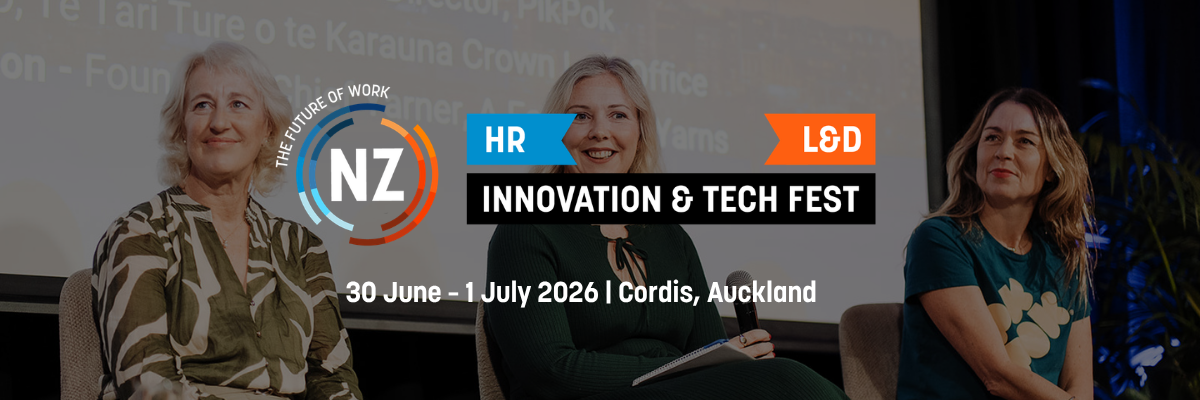
With two days of practical insights, thought-provoking discussions and real-world examples, HR + L&D Innovation & Tech Fest NZ is your opportunity to explore the ideas, technologies and approaches shaping the future of work.
30 June - 1 July | Cordis Auckland
This is an event not to be missed.
Secure your tickets online or get in touch with the team.
)
)
)
)
)
)
)
)
)
)